

In the book of Acts, we read that tongues of fire lit upon the disciples of Jesus.
Jews from all over the ancient world gathered that day in Jerusalem to celebrate the Feast of Weeks. On the fiftieth day after Passover, pilgrims streamed into the holy city for the annual harvest festival. As Gospel writer Luke tells the story, seekers surged from cities like Mesopotamia and Cappadocia, from islands like Crete, from the deserts of Arabia, from Rome itself, from—as Luke puts it—“every nation living under heaven.” The tongues of fire spread like brush aflame, sweeping the city and provoking a miraculous ability to speak in different languages. The centripetal force of the Roman Empire favored one language, Greek—and yet on this day, people from diverse lands heard home languages spoken not by the imperial elite, but by uneducated Galilean peasants like Peter.
Some were terrified.
Some were outraged.
Some blamed it on wine.
Some were inspired.
The impact and chaos of this dramatic occasion prompted the failed and forgiven disciple Peter to shout a sermon with fiery tongue, stirred with a twist of brimstone. Luke writes that Peter quoted the prophet Joel that day:
In the last days it shall be, that I will pour out my Spirit upon all flesh. Your sons and daughters shall prophesy. Your young men shall see visions, your old men shall dream dreams. And I will show portents in the heavens above and signs on the earth below, blood, and fire, and smoky mist. (Acts 2:17-20)
Luke’s story boasts that Peter’s words torched three thousand hearts that day. The disciples enacted a mass baptism on the spot as a way of signaling in ritual form the Spirit’s transformation through tongues, as of fire.
Spirit and fire have a long history together.
In the Bible, God is perpetually revealing angels or the divine mystery itself through fire’s unforgettable burn.
Moses stood at the foot of Mt Horeb and encountered an angel who appeared to him in a burning bush.
God issued the Israelites’ Ten Commandments through a fiery billow: Before God spoke the words of Torah, God’s presence descended upon Mount Sinai in fire, and smoke filled the sky—as if from an industrial smokestack, but without the negative ecological implications.
In the book of Leviticus, after the priest Aaron’s ordination day, God’s fire from heaven burned up and consumed the animal offering.
Fire features in ancient mystical visions like that of Ezekiel or Daniel’s divine chariot.
Towards the end of the Bible, the ancient fantasy book Revelation pictures the Son of God, Jesus, with eyes flickering like a flame of fire (Rev. 1:18).
And in Luke’s Gospel, John the Baptist tells of Jesus’ s coming ministry with this ominous phrase: “He will baptize you with the Holy Spirit and with fire” (Luke 3:16).
Fire has dangerous edges.
It’s hot.
It burns.
It scars.
It kills.
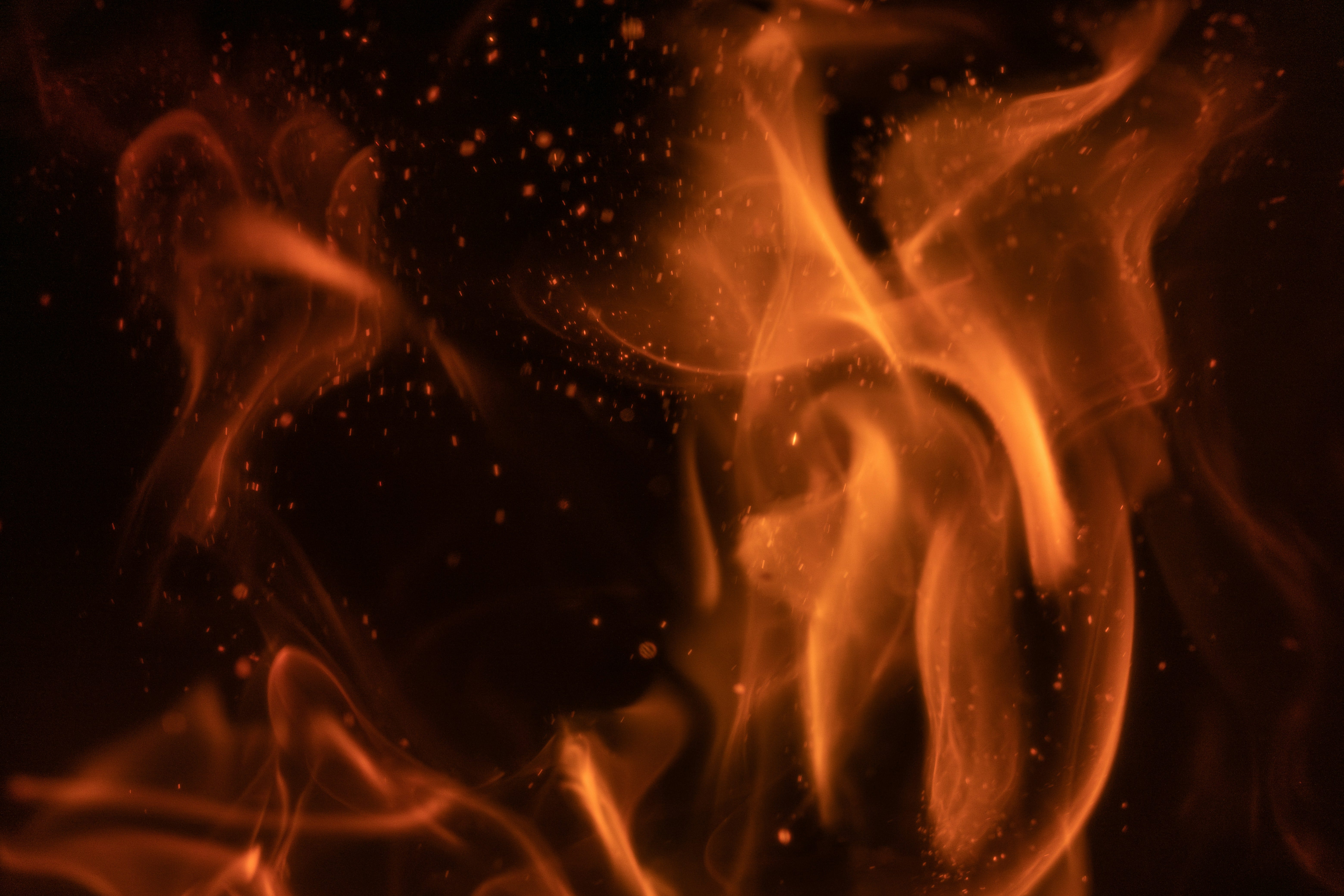
Photo by Nadiia Ploshchenko 🇺🇦 on Unsplash
Street corner preachers often corner fire’s market by wearing sandwich boards declaring the end is near. Their boards carry flames or nuclear clouds, cheap paint displayed on plastic.
Yet I’m convinced we have to admit that fundamentalist fire finds its originating spark not only in misguided hearts and minds, but also in our texts and traditions. Revelation speaks of fire raining down from heaven, but even beloved prophets like Isaiah imagine God’s fury boiling over with fire (Isaiah 66:15-16). The fire of judgment, anger, retributive justice, and violence burns through Scripture and tradition.
Perhaps that’s a way of signaling that when it comes to fire and sacred text, we humans are careless?
In the book of Acts, the Spirit is the catalyst, like fire, for spreading and propelling a movement. The Spirit primarily reveals Her personality and heart in Luke’s tale not through judgment, but through mission. After an entire Gospel of Peter’s impulsive, foot-in-mouth moments, culminating in his denial of Jesus not once, but three times, we witness Peter finally find the converging mission of his life. And even if Luke is rounding up the numbers of converts in this passage like a televangelist, Peter’s passionate Pentecost speech must have been something to remember.
The trajectory of the book of Acts tells a story about the Spirit’s explosive appearance at Pentecost and the outward movement of love and inclusion that follows. This Spirit story starts in Jerusalem with a particular people and religion and, after the usual internal conflicts, personality struggles, a shipwreck, and some prison time, the story ends in Rome as universal good news for everyone. Spirit’s fire catalyzes and clarifies mission.
We fear fire.
Traditional religion often becomes protection against the Spirit’s transformation and mission. Churches become bastions against disruption, change, and solidarity, instead resembling rotary clubs instead of social movements. The Spirit then insists on moving elsewhere—because the Spirit’s flame cannot be contained.
The wisdom of desert father Abba Joseph from the fourth century captures both our religious plight and Spirit’s fiery invitation: A fellow monk went to see him and said:
Abba, as far as I can I say my little prayers, I fast a little, I meditate, I live in peace and as far as I can, I purify my thoughts. What else can I do?” Then the old man stood up and stretched his hands toward heaven. His fingers became like ten lamps of fire and he said to him, “if you will, you can become all flame.
This is a Pentecost sermon I’ve been wanting to share on Pentecost Sunday for a couple of years now! Have a great week, everyone.